

The following was submitted by EBSCO Audiovisual Archive Fellow, Ron Harris.
I’m Ron Harris, a graduate of the University of Alabama’s School of Library and Information Studies (SLIS) and an EBSCO Audiovisual Archive Fellow. While pursuing my graduate degree, I was located in Raleigh, North Carolina, where I interned at the Media Archives of PBS North Carolina. PBS North Carolina is situated in Research Triangle Park, on the border of Raleigh and Durham.
Managed by the University of North Carolina-Chapel Hill, PBS North Carolina’s media archives handle broadcasts from the local PBS affiliate and other localized media, such as recordings of UNC System Board of Trustees meetings.
My experience at PBS North Carolina was generally seamless, though not without challenges. I was scheduled to start my internship in August 2023, but due to state budget issues, PBS North Carolina could not take on an intern until October 2023. This delay left me with 150 hours to complete between then and December. Fortunately, my site manager was very understanding and helped me adjust my schedule to complete my hours. I began with on-site digitization and was also given remote tasks such as cataloging.
I was responsible for digitizing two shows: Education Forum and High School
Education Forum was the precursor to High School Assembly. It was a roundtable-style show that highlighted trending topics in North Carolina education. High School Assembly featured a panel of subject matter experts discussing a specific topic, taped live in front of a studio audience of local high school students. Topics included prom, gun violence, athletics, and many other teen-centered issues. All these series were recorded on Betacam HD tapes.
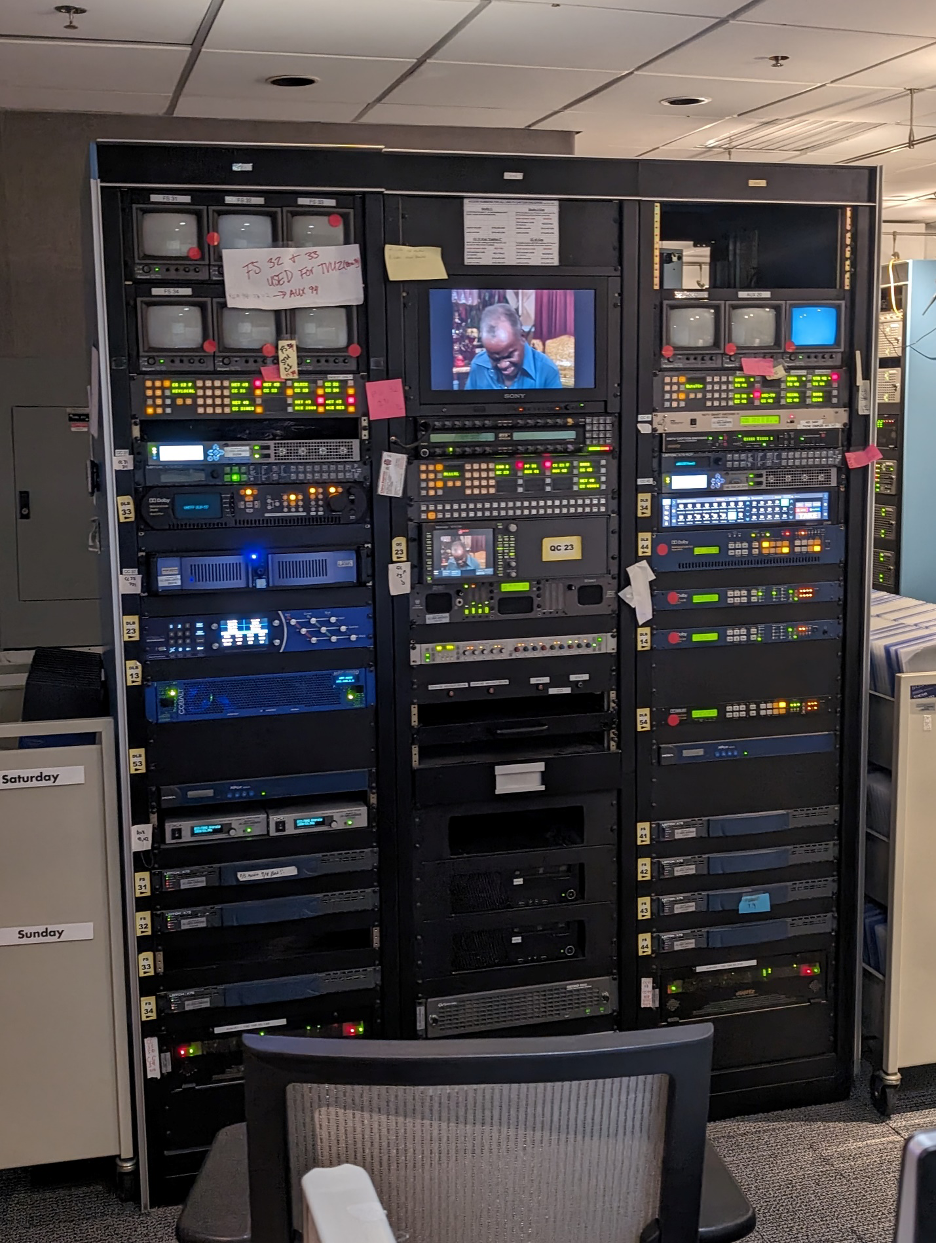
To capture digital files for both the station and my work, I had to find a workaround. My site uses digital asset management software called Dalet, which captures, organizes, and adds metadata to digital files. Initially, I thought I would need to run the tapes twice—once for the DAM and once to capture my files using a capture card Fortunately, I informed of the newfound embracing of Matroska files. Dalet captures files in mastroka, which means I can just pull my captures from the DAM. This saved a lot of time and duplicitous workflow.


My site’s setup allowed me to run multiple tapes simultaneously. To ensure accuracy over speed, I started digitizing three or four tapes at a time instead of seven. As I became more comfortable, I increased the number. The DAM interface was all-in-one, enabling me to perform quality control checks while the tapes were recording.
Once the tapes were recorded, a master and access-level file were created. I ran a script to move the files onto my hard drive and then ran checksums on each file to ensure integrity.
Overall, my experience was smooth. My only wish was for more troubleshooting opportunities. Regardless, I am grateful for the excellent experience at PBS North Carolina, and I gained valuable skills that I hope to apply in the future.


 blog.americanarchive.org